

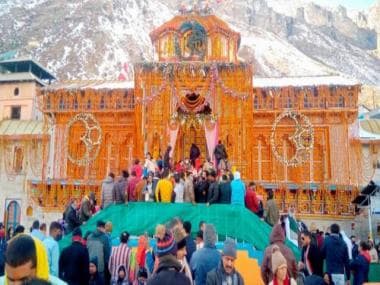
In the last 35 days, 62 pilgrims have lost their lives due to heart problems and other sicknesses in Kedarnath, 35 at Yamunotri, 34 at Badrinath, and 11 pilgrims at Gangotri
At least 142 pilgrims have died in the last 35 days due to heart problems and other illnesses at Char Dham in Uttarakhand. Devotees in big numbers are heading for Badrinath, Kedarnath, Gangotri and Yamunotri — popularly called Char Dham — this season. The high attendance of pilgrims has created management crises for the Uttarakhand government and to control the number, online registration for visitors has been introduced by the Uttarakhand tourism department.
According to the state disaster management cell, this year (till 6 June), 62 pilgrims have lost their lives due to heart problems and other sicknesses in Kedarnath, 35 others at Yamunotri, 34 at Badrinath and 11 at Gangotri. The highest deaths were registered at Kedarnath and Yamunotri — where a visitor has to undertake a trek to reach the shrine. Uttarakhand tourism secretary Dilip Jawalkar said, “In 2019, we registered 34 lakh pilgrims at the Char Dhams, but this year we have touched the 16 lakh mark in one month. This indicates the growing popularity and attraction of the Char Dhams.”

In a move to control the number of visitors touring Badrinath, Kedarnath, Gangotri and Yamunotri, the Uttarakhand government has made online registration on https://registrationandtouristcare.uk.gov.in mandatory and daily number of pilgrims in each of the four shrines has been fixed. A maximum of 8,000 pilgrims can visit Gangotri and 5,000 can tour Yamunotri daily. Only 13,000 pilgrims will be allowed to visit Kedarnath and 16,000 to Badrinath daily. The Uttarakhand government has fixed the number by taking the carrying capacity of each pilgrimage centre.
This year Badrinath has so far attracted 5.75 lakh tourists, Kedarnath 5.45 lakh, Gangotri 3.05 lakh and Yamunotri 2.31 lakh visitors. The heavy rush of devotees has provided the tourism industry in Uttarakhand a big relief. But, the high causality of pilgrims at Char Dhams has forced the state government to enforce health screening of the visitors at different points. The high death forced the state government to form a committee of experts to provide their expertise on the casualties and ways to minimise them.
The committee in its study states that 60 per cent of the deaths took place as they were suffering from co-morbidity and most of them were over 50 years of age. The committee in its report, submitted to the state government on 5 June 2022, suggests that old people, Covid infected and people suffering from various illnesses should only undertake the Char Dham Yatra after medical tests and consulting doctors. The committee also advises a 48 hour acclimatisation period for pilgrims and asks them to maintain caution.
Uttarakhand health secretary Radhika Jha said, “Pilgrims coming from the plains without any break have to face adverse health conditions in visiting the dhams located in the high Himalayan regions. Cases of breathlessness, hypothermia and heart attack are prominent. It has also been observed that it takes time for the pilgrims to get used to the weather and environment of the hills. As a result of all these reasons, every year unfortunate death due to cardiac arrest takes place. In 2017 also there were 112 unfortunate deaths of pilgrims.”

The Uttarakhand government has introduced health screening facilities for visitors for the first time in the hill state. These screening facilities are available at nine places — Gauchar, Pandukesar, Sonprayag, Jagwari bypass, Kund bridge, Dobata, Janki Chatti, Hina and Gangotri.
The portals of Gangotri and Yamunotri were thrown open for devotees earlier this year on 3 May. Kedarnath reopened after six months of winter break on 6 May, and Badrinath on 8 May. With the opening of the Badrinath shrine, the Char Dham pilgrimage became fully functional. In the past the annual pilgrimage to Badrinath, Kedarnath, Gangotri and Yamunotri used to peak after 15-20 May, but this time it was a totally different story. The Char Dhams were packed to capacity from Day 1. It is a general tendency that the pilgrimage slows down on 15-20 June. Will the same trend prevail this time? Nobody knows.
***
Also Read
Sudden rush of pilgrims in Kedarnath demands better tourism management
***
The tourism data of Badrinath and Kedarnath of the last 21 years presents an interesting picture. In 1990, the total number of pilgrims visiting Badrinath was 3.62 lakh, and in 1995 touched 4.61 lakh. It jumped to 7.35 lakh in 2000, dropped to 5.66 Lakh in 2005, progressed to 9.21 lakh in 2010 and suffered a major blow after the 2013 flashflood to register 1.80 lakh visitors in 2014. In 2017 Badrinath attracted 8.84 lakh visitors and this time a record 5.75 lakh have reached the pilgrim town in over one month.
The case of Kedarnath is similar. From 1.17 lakh tourists in 1990, Kedarnath attracted 1.05 lakh tourists in 1995, which increased to 2.15 lakh in 2000 and 3.90 lakh in 2005. After recording an all-time high of 5.83 lakh in 2012, Kedarnath registered the lowest arrival with a mere 40,832 visitors in 2014. After 2017, when 4.71 pilgrims visited the pilgrimage town, 5.43 lakh pilgrims have so far toured Kedarnath. Both Badrinath and Kedarnath are all set to attract record pilgrims this season.

Over a hundred mules have died in Kedarnath due to ill-treatment and working without rest. Reports about cruelty against animals taking place in Kedarnath compelled Saurabh Bahuguna, Uttarakhand’s Minister for Animal Husbandry, to visit and inspect ground reality. He was in the Mandakini valley recently. Admitting death of 129 mules in Kedarnath, Uttarakhand Animal Husbandry Minister had disclosed data on his Twitter handle about registering FIR against seven mule owners, imposing a fine on 62 others, disallowing operation of 297 unfit mules and forcing the withdrawal of 93 other mules.
Regular visits by Prime Minister Narendra Modi have created a lot of interest about Kedarnath in the public. The cave where Prime Minister Modi had stayed in 2019 in Kedarnath has become a big hit among tourists. Heavy booking for the meditation cave exists and Rudra cave has been booked till the first week of July.
Sudarshan Khatri, regional manager of Garhwal Mandal Vikas Nigam, said, “We are presently managing three meditation caves in Kedarnath. The cave where Prime Minister Narendra Modi had stayed remains the most popular of all, in two other caves the response is low. Electricity and water is available at the Rudra cave, we provide juice and fruits to the tourists.”
Read all the Latest News, Trending News, Cricket News, Bollywood News,
India News and Entertainment News here. Follow us on Facebook, Twitter and Instagram.