

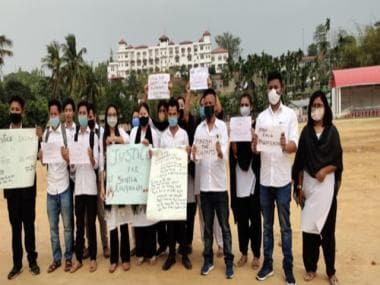
Amid the turmoil of the pandemic, unrest is brewing in the Nagaon district of Assam. The body of a 12-year-old girl who was a domestic worker was found burnt outside the house of her owner on 22 April in the Khaighar village. The girl was a Karbi (one of Assam’s indigenous communities) and the employer belongs to the Brahmin community.
Protests have erupted in the entire Karbi Anglong region, between which the Nagaon district also lies. Among the demands of the protest are a proper and fair investigation.
“We do not have the full post-mortem report yet, so we do not even know how she died,” says Babu Ronghang, the uncle of the victim. “We need to start the ritual for the body following our Karbi traditions. How do we do that when the post-mortem is pending?”
There is also the suspicion that the girl was sexually assaulted.
“The owner of a nearby pharmacy has confirmed it,” says Thangsing Timung, the president of Karbi Students Association. The pharmacy owner said that the Borthakurs purchased contraceptive pills and that he is also ready to testify in court.
The neighbours of the perpetrators also said that the Borthakurs allegedly sexually assaulted the girl and killed her. Five people were also arrested for allegedly trying to burn the Borthakur house.
“Why is the police not taking into account the testimony of the pharmacist and the neighbours? The investigation is not happening properly and that is what we are holding protests for. The truth must be out,” Timung says. The Borthakurs have also alleged that the victim died by suicide, by pouring kerosene on herself. But this claim has been heavily disputed.
As Timung describes, the neighbours heard no screams, no sounds that would be typical of a person who is burning. This has led to an assumption that the victim may have been killed first and later burnt.
“We have seen how routine this child labor has become,” says Sabin Rongpipi, a youth Karbi activist. “The Karbi families who are very poor are lured with promises of good education for their kids and money. Then their kids are taken away, never to be heard from again,” she adds.
Sabin’s mother, Kajek Tokbipi who has been an activist and is the general secretary of Karbi Nimso Chingthur Asong, an organisation fighting for women’s rights since 1986 also had a lot to add about how the kids are taken.
“There are these sellers in the weekly market, who are acquaintances for both the people from Karbi Anglong and Nagaon. They identify which Nagaon family needs a kid, and which Karbi family can give a kid. In this way, the child is taken away. Sometimes, these middlemen huddle 20-30 children in a bus. They are then taken to a house in Nagaon where they are sold,” she says.
“It has become a trend that after the age of six years, a child has to go to Nagaon. Many families themselves go and drop their kids there, in hope of a better future,” Sabin chips in. “There are many different ways in which Karbi children are taken — some forcefully, some voluntarily, but the fact of the matter remains that it is the Karbi children who are taken,” she adds.
Ronghang describes how the victim and her siblings were taken away. “It starts with one kid,” he describes. “Some acquaintances from Raha (a small town in Nagaon) come and talk to them, and then casually ask if they want their kids to have a good life. They are very convincing. They ask, ‘Do you want to keep the kid there? Shall we show you the house? We can even make a video call. Your kids will have a good environment there.’ It’s through that one kid that the acquaintances will get to know more families, and more kids,” he says.
Some more activists have seen it function as a business.
“I have seen three-four agents take the kids and keep them in a house,” says Avijit Kro from the Nagaon Karbi Students Association. “They sell the kids for ₹5,000-₹7,000,” he adds. Thangsing Timung also echoes the same experience. He says, “There are some agents who get children from isolated areas and sell them.” He also adds that in 2018, a women’s organisation in West Karbi Anglong caught a guy who used to ask Rs 10,000/- from rich families in Nagaon to get Karbi children.
Kro also highlights how routine these incidents are. He recounts how last year, an eight-year-old boy ran away from Nagaon and walked 67 km on foot to reach back to his home. The owner used to beat him profusely, and he was just four years old when he was taken away. Similarly, in 2019, a 12-year-old domestic worker was found pregnant in Raha. She even gave birth to the child.
Her employers had raped her and they were sent to jail for the same. However, four months later, they were out and free. The girl still lives with the baby. In 2017, the dead body of an eight-year-old Karbi boy was found in a school in Nagaon. But according to Kro and many others, neither were these cases properly investigated nor did any non-Karbi organizations raise these issues.
Since 2015, Kro has taken bodies of Karbi children from Nagaon to Karbi Anglong. He has dropped some children back home alive, and some dead. He has adopted two kids who were rescued from Nagaon after running away.
It is contrasting to see the poverty in Karbi Anglong and the affluence in the Nagaon district, which is right between the two parts of Karbi Anglong. But this contrast has a reason.
“Karbi people are seen as junglees and uncivilised,” says Sabin. The indigenous Karbi community of Assam, already a minority, faces microaggressions and discrimination that enable the commodification of their kids. Kro tells how Karbi kids are often taken because they are looked down upon. According to the experiences of the kids whom Kro adopted, they could not even eat food in front of the owner or the owner’s house. Some children can also not enter the kitchen of the owners’ houses.
Dharam Sing Teron, a renowned activist from Karbi Anglong and a former MLA affirms that the indigenous identity of Karbi children is what gets them trafficked. “There is no strong support system for Karbis. And that is a given because all people in power are from a dominant society,” he says. The coronavirus pandemic also increased the frequency of kids being taken away. “During the pandemic, prices increased. Transport fare was hiked, and whatever little markets existed for Karbis to get a livelihood from crumbled down due to restrictions. There is no true leadership as well. Hence, more kids were being sent away,” Teron adds.
Most Karbi families are daily wagers, earning ₹100-₹200 per day, at most. The work involves the construction of homes and wells and the selling of bamboo mats in Raha that they make themselves. During the pandemic and especially the lockdown, even this source of income is gone in the absence of any institutional support. The pandemic has also made things worse legally. Many cases are still pending in courts, and the owners have found another excuse not to let the children meet their families.
Sabin highlights how the first thing that owners do on getting the kids is erasing their identity. “Karbi kids are made to forget every essence of their indigenous being. Their names are changed from their traditional Karbi names to more modern, Assamese names. They are taught the Assamese language for two years. So even when the parents try to talk to their children, they cannot, because the kid does not know how to speak in the Karbi language. Finding them also becomes difficult as the kids have a new name and identity,” she says.
Timung describes just one of the ways in which kids are not allowed to see their parents. “If the parents try to meet their kids, the owners ask them for their Aadhar card, which the parents usually do not have,” he says.
Gaurav Abhijit is the Superintendent of Police in Nagaon and is from Maharashtra. From his experience in the district, he says, “The justice system is strong here because there is no hierarchy in the society.” However, Kro disagrees. “It has become a culture to keep Karbi kids as slaves,” he says. Teron also adds, “Because of the economic and social situation of Karbi families, they feel that keeping their children in the big homes of Nagaon is a safer option.”
One of the biggest reasons why Karbi families send their kids to Nagaon is the lack of school and infrastructure to enable studying, like electricity and other civic amenities. That is why many Karbis think that the starting point to end child labor is to build schools. “We have schools only up to the 5th standard. Also, just one teacher is teaching the entire school. The children also have to walk 10 km on foot to reach the school. So proper schools need to be built,” says Ronghang.
The victim’s siblings and many other children who were trapped have now returned home because of the heightened awareness from this incident about child labor. Most perpetrators in the past have gone unpunished, and the Karbis have little legal, economic, and social resources to fight back. All that they can do is protest. But there is a glimmer of hope amidst all the protests. Since the victim’s case got traction, many families hope that they and their kids will get traction and justice too. As Sabin says, “The victim and her story touched our hearts and our lives.”